




New York’s public swimming pools are vital pieces of social infrastructure, yet decades of underinvestment have left many in disrepair. After visiting four city pools, WXY architect Nick Hornig argues that better design, sustained funding and more imaginative financing are needed to make high-quality swimming facilities accessible to all New Yorkers.
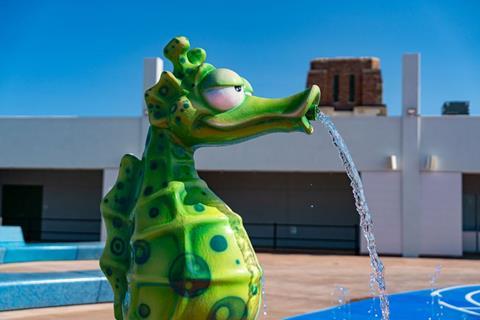
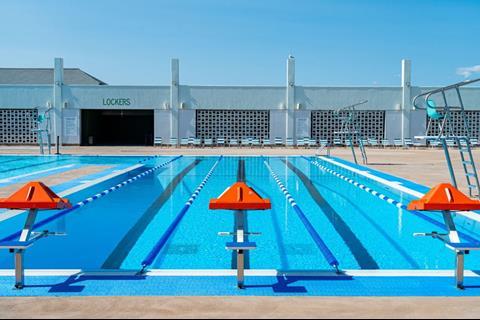
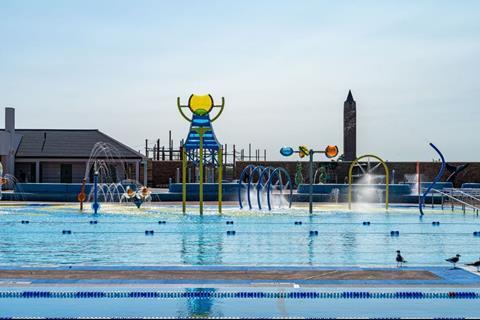
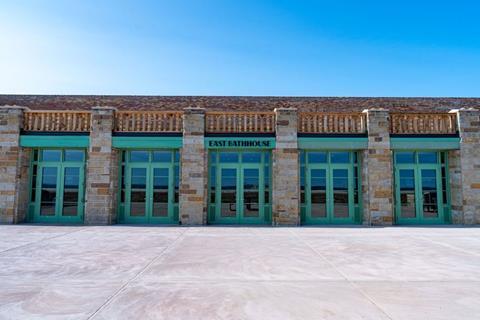
It is late July on Long Island, the height of summer, and New York State governor Kathy Hochul is giving a speech to mark the opening of Jones Beach East Bathhouse. As soon as she finishes speaking, a waist-high gaggle of kids races past her towards the pool. They wade in with joyful determination past fiberglass seahorses spraying jets of water that sparkle in the sunlight.
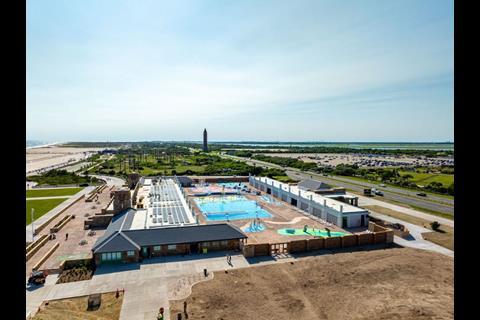
I was one of WXY architecture + urban design’s team, working on the construction documents for the $100 million rehabilitation of this Robert Moses era bathhouse, designed by architect Herbert Magoon and located on the Atlantic Coast about 35 miles east of Manhattan. First opened in 1929, generations of local children enjoyed learning to swim here but due to budget cuts it had been shuttered since 2009. The Governor’s $260 million “NYSWIMS” initiative paid for the renovations - which aim to improve access to swimming facilities throughout the state.

Working with the New York State Office of Parks, Recreation and Historic Preservation, we restored the Beaux-Arts meets Art-Deco buildings’ tide and time clocks on the brick towers facing the ocean and the historic lanterns in the north pavilion. We restored and insulated existing roofs, inserted new accessible changing rooms and restrooms, a cafe serving swimmers and beach goers, as well as life guard training facilities. We replaced the 1960s pool with an accessible “zero entry” learn-to-swim pool and two large splash pads. We installed new all electric heating and water filtration systems, powered in part by rooftop photovoltaics and geothermal wells in the adjacent dunes. We designed flood vents into elegant new storefronts and engineered openings in the perimeter brick walls to safely handle floodwaters, an essential measure for a site exposed to rising tides.
The opening ceremony made me reflect on the significance of public pools. They are elements of critical urban infrastructure. Yet New York City treats them like amenities to be run at minimal operational viability. Why can’t more kids access safe, welcoming swimming facilities in a city with some of the highest concentrations of wealth in the world?
Swimming pools are essential for public health. The CDC (US Centers for Disease Control and Prevention) says drowning is the leading cause of death for ages one to four, with over 4,000 deaths a year across all ages. Swimming pools also play a vital role in climate and community resilience: providing spaces for play, exercise and respite as the temperatures and humidity soar for longer stretches each summer. Access is uneven: Manhattan is best served with 65% of its residents within 15 minutes’ walk of a public pool. Queens is the least well served with just 12%.
New York City’s Department of Parks and Recreation (NYC Parks) maintains 91 public swimming pools for its 8.5 million residents, 79 of which are outdoor. 2026 marks 90 years since the opening of many of these pools. Mayor Mamdani celebrated this anniversary at the start of summer by jumping into the Thomas Jefferson Pool in East Harlem still wearing his suit. The pools are free and open to the public from late June until mid-September from 11am to 7pm (closing for cleaning between 3-4pm).
But these facilities have faced cyclical funding cuts, meaning fewer lifeguards, reduced numbers of lanes to swim in, delaminating tiles and failing pool systems that can delay opening months into the heat of the summer. Visitor numbers have dropped by some 35% from a peak of 1.7 million in 2018 to 1.1 million visitors in 2025.
To see what was going on for myself, I packed my padlock, white t-shirt (as required by NYC Parks) and biked off to four local city pools.
Kosciuszko Pool opened in 1971. Designed by Morris Lapidus, a locally raised architect who was also behind the Fontainebleau Hotel in Miami Beach. Fontainebleau is a 1,500 room, curvilinear cruise-ship of a building where Liberace played at the opening. Back in Brooklyn, the pool complex is a concrete landscape of stepped plinths and angular walls, wedged between the brownstone terraces of Bed Stuy, Bedford Stuyvesant, a mixed income neighborhood. Hipsters and longer-term residents politely negotiate one another in their bathing costumes on the pool deck.
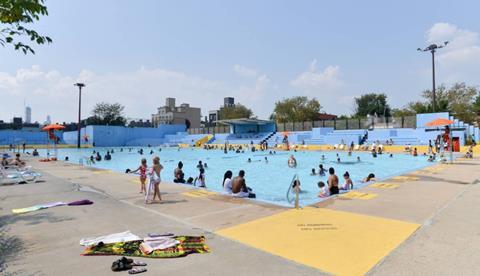
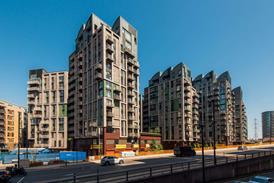
A new 7 story affordable residential complex has sprung up to the west, but the pool has been left to disintegrate. It was last renovated during Mayor Giuliani’s administration between 1994-2000. The changing rooms are spartan windowless LED-lit subterranean spaces, the showers dribble down the stained walls. A pair of ramps funnel visitors down into the facility from street level and then up to the pool deck; stepped concrete bleachers with a concrete cantilevered roof line the north side of the pool. The pool is large - 70 x 30m; the diving pool has been filled in; the kids’ wading pool is closed. There is only concrete to lie on after a swim. The concrete seating and site walls have been covered in blue paint, cracking in the sun. The result is utilitarian, penitentiary. I spy that one of a handful of white plastic sun loungers has become free and I swoop in, with the same urgency of grabbing a seat on the subway.
The following Saturday, I bike up to Sunset Park in South Brooklyn hoping for more comfort. Herbert Magoon (the same Magoon who design Jones Beach) and Aymar Embery II designed this in 1936: a brick entry rotunda symmetrically flanked by low brick changing rooms. The complex was funded by the WPA or “Works Progress Administration:” President Franklin D Roosevelt’s program that provided paid jobs to unemployed Americans during the Great Depression. Robert Moses and Mayor LaGuardia used these federal funds to build many of the pools, parks, highways that dominate the city’s landscape today.
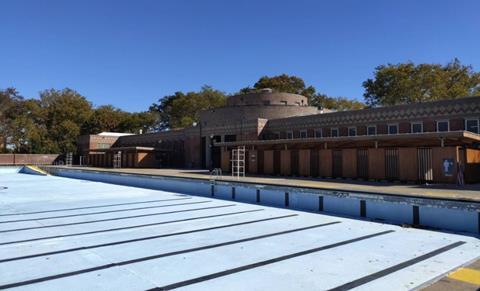
Parsons School of Design students designed and built temporary exterior changing rooms in 2015 to compensate for the deterioration of the buildings, and 11 years later these structures still stand on the south side of the pool deck. A 300mm timber diagrid topped with a polycarbonate roof floats on elegant steel columns, providing shelter to the changing areas below. The rectangular pool is 80 x 50 m with giant blue painted concrete “emergent pyramids” positioned at each end of the pool to help life guards judge distances in the blue expanse. The neighboring park’s trees surrounding the site provide an almost bucolic setting. The patron on the lounger next to me, with a heavy Brooklyn accent and gold chain, talks loudly about how he and his friends use to climb up on to the concrete pyramids as kids: “We used to get into some good fights here!”
The next week I try the Sol Goldman Rec Center in Red Hook, and things take a turn for the worse. This is another WPA funded project. Opened in 1936, the complex was also designed by Aymar Embury II this time with Joseph L Hautman. It was last renovated in 1983. It’s adjacent to a large public housing project; and close to Brooklyn’s Ikea, and an Amazon distribution center. The men’s changing area is currently located in the gym. Metal barricades usually used for crowd control separate swimmers from the gym equipment. To reach the pool, visitors shuffle through the dimly lit changing and shower rooms to the deck. I feel sorry for the polite staff ushering patrons through. I don’t want to look too closely, but I can see the wall paint is peeling, tiles are stained and a toilet cubicle door hangs askew. It smells of bleach and mildew.
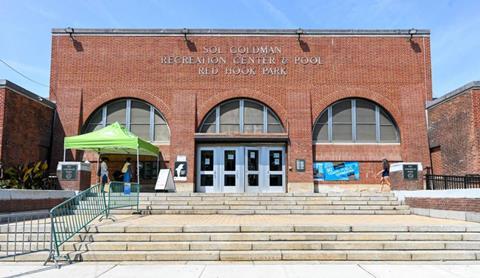
The pool itself is sparkling - and the water clear. Despite the changing rooms, it is still thrilling to swim outside in the city, with the sun warming your back and the NYC Parks’ maple leaf logo stretching out beneath you in the dappled sunlight. A colleague told me that he wouldn’t go back to Red Hook with his daughter after a recent visit, but I hope he will soon. NYC Parks have slated this site for a $122 million revamp, with construction starting in 2028.
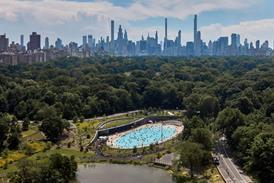
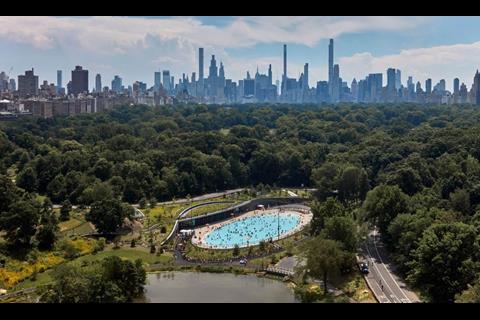
On the last weekend in August, I bike to the Gottesman Pool at the northern end of Central Park. Designed by Susan T Rodriguez Architecture and Design, the complex opened in the summer of 2025, replacing the Lasker Pool that had stood here since 1966. The changing rooms and communal area are buried into the hillside under an intensive green roof. A continuous skylight brings daylight deep into the plan, and a gently convex-curved wall of 4.2m tall glass doors opens on to the pool deck to the west.
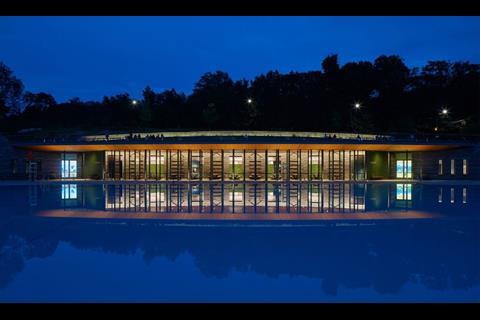
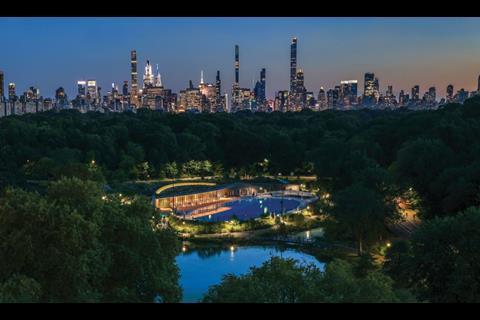
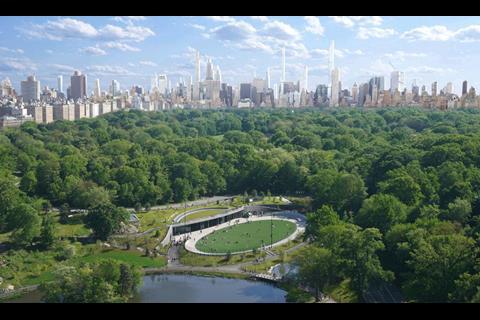
Once I’ve changed, the showers are hot and powerful. Perfect after a 15-mile bike ride. A little elated, I stride into the communal room, admiring the forest green tiles that embrace the changing rooms to the east, and the thin charcoal painted steel structure that slices through the wood grille ceiling above.
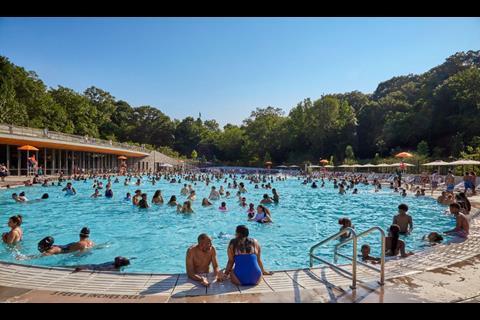
Outside, a group of kids is already creating a noisy haze of splashing, flailing limbs in the center of the oval pool. Without any corners, this 85 x 35 m pool fills the horizon; it seems endless. An old hand by now, I have arrived early for the afternoon swim session and bag a lounger at the northern end of the pool. The water laps over the edge, elegantly into a concealed drain. I feel like I have snuck into an expensive country club without paying admission.
The Gottesman Pool was made possible by a public private partnership, combining $60 million in city funds and $100 million raised by the Central Park Conservancy. Come autumn, a modular flooring system is installed over the pool bed to create the Harlem Oval - a lawn for games, walking and relaxing. In the winter this converts into a full-sized skating rink offering community skating, lessons and ice hockey clinics.
On my last lap across a short width of the oval, I bump into an Australian friend who is also an architect. We agree it’s just wonderful to find such a well-designed, free-to-enter facility in the heart of this city; and to see such a diverse crowd enjoying its generosity. Between observations he does a handstand in the water, perhaps to celebrate.
So then, back to my original question: why can’t all kids in New York access such beautiful pools as Jones Beach East Bathhouse or the Gottesman? The answer is money and politics. It depends on the city’s funding cycles; it depends on each neighbourhood’s own capital resources and collective agency; and it depends whether a pool’s improvement happens to serve an elected official’s target constituents. It also depends on whether the pool is city or state operated: they are funded differently. City pools are kept free, paid for by city tax revenues - in direct competition with other municipal services. NY State-operated pools are able to charge fees and are paid for through government bonds.
Our previous Mayor Adams committed $1 billion in funding, targeting 39 city pools - that will deliver renovations up until the end of 2028. This is welcome, but the timing and scope are reactive rather than sustained and systematic.
Meanwhile, older, inventive approaches to providing pools to underserved communities have re-emerged. Between 1870 and 1932, 22 floating pools were moored on the Hudson and East Rivers. In 2007 the “floating lady”: a decommissioned barge-turned-swimming pool was deployed on the East River. It currently serves the Hunts Point Community in the South Bronx. Another, the Plus Pool, was first envisaged in 2010 by PlayLab Inc, will filter river water into a striking cruciform floating enclosure that will provide four different zones: a kids’ pool, a sports pool, a lap pool, and a lounge pool. The prototype is set to finally go into operation in the summer of 2027. Detractors point to lengthy bureaucratic delays; its siting on the East River which is itself a highly congested, polluted tidal strait; and the diversion of city funds from renovating existing facilities.
I think architects have a role to play in supporting public swimming pools that is simpler and more effective than devising technically complex, expensive floating contrivances. We can work with engineers to reduce operational costs, and environmental impacts as at Jones Beach, and we can propose programming that activates these facilities year-round as at the Gottesman. And we should also be making the case to city government that pools deserve consistent funding. This can be drawn from across relevant funding sources: education, healthcare and infrastructure budgets, as well as NYC Parks. And in a city that needs to build 700,000 new housing units in the next 10 years, we should also advocate for transparent developer contributions to support neighbourhood pools. There are other funding models – for example we could look to Germany, where municipalities team up with local utilities companies to create “Stadtwerke” where - put very simply - the profits of one agency support the loss making, but essential services of the other.
New York can afford to be more inventive in how it funds and provides its pools. Modern, welcoming facilities like Jones Beach East Bathhouse and the Gottesman pool should not be the exception. NYC public pools should not be left to rely on one-off capital injections that come once every 30 years.
Back in Central Park, it is time to go. Imbued with the generosity of the place I tell my friend to throw his towel on my sun lounger – before anyone else takes it - and I set off on my bike back to Brooklyn.
Postscript






1 Readers' comment