

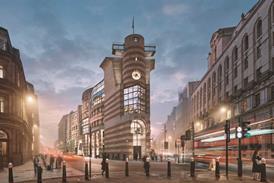




Philip Palumbo said his family wanted to ’dispel any suggestion that we are in agreement’ with John Robertson Architects-designed facelift
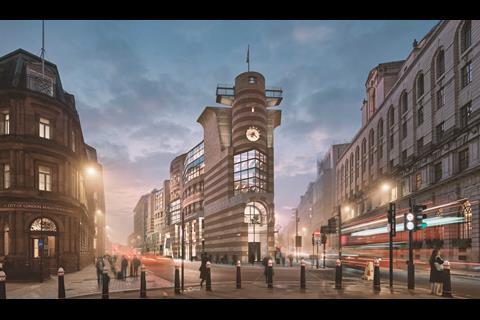
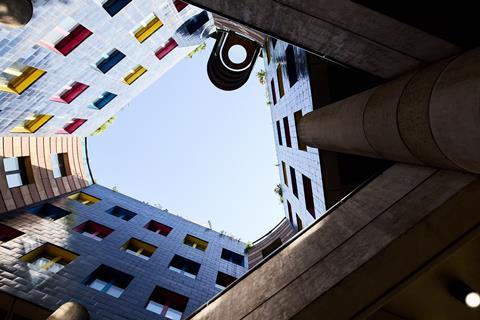
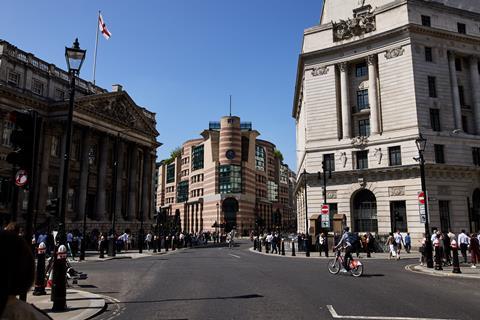
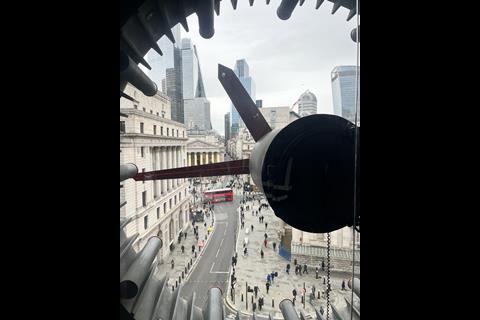
The family which built James Stirling’s landmark No 1 Poultry has spoken out against a planned refurbishment of the City office building, describing the scheme as “meddle to the point of mutilation”.
Philip Palumbo, son of property developer and former peer Peter Palumbo, said his family wished to “express our strongest disapproval” of the plan to bring the grade II*-listed building up to modern occupier standards.
The comments, posted on the scheme’s planning application earlier this month, came ahead of today’s decision by the City of London to approve the John Robertson Architects-designed project.
The Square Mile’s planning committee voted nine in favour and six against, with one abstention, this morning for a recommendation from planning officers to green light the refurbishment, which was submitted in December.
Originally completed in 1997 by John Laing, five years after Stirling’s death and following more than a decade of planning wrangles, the building has since been recognised as one of the most significant examples of British Postmodernism.
But it has been vacant since October last year when serviced office provider We Work moved out with developer Fore Partnership and South Korean investor IGIS Asset Management seeking to reposition the site as a headquarters building.
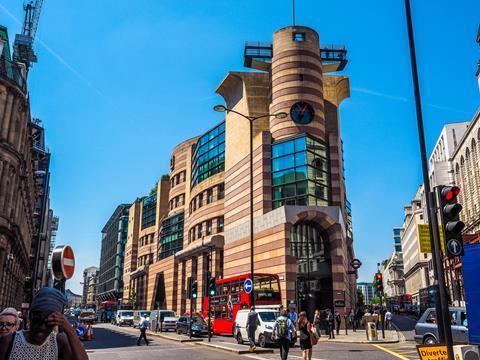
The Palumbo family’s objection is among several posted by individuals involved in the original development of the building, including the former directors of the architectural practice James Stirling Michael Walford and Associates Ltd (JSMWA).
John Robertson Architect’s (JRA) proposals would reopen the grand arrival corridor on the ‘apex’ corner of the building’s ground floor, which has been largely closed since the building opened, as the building’s main public entrance.
However the long staircase, inspired by processional routes from antiquity and called the Scala Regia by the building’s architects, will be mostly closed to the public and sealed behind a pair of glazed doors for security reasons.
Both the staircase and the ’rotunda’ space it leads to at the centre of the building will only be accessible during public “curated events”, of which there will be a minimum of 12 per year under the conditions of the planning approval.
Meanwhile, the building’s original lifts, which were designed to provide views of Bank junction as they rise, will be reserved for office occupiers only and their ground and first floor entrances sealed off with metal panels.
Palumbo said: “The overarching problem with the proposals is that they meddle to the point of mutilation with the design of the late Sir James Stirling, who was widely acclaimed as amongst our country’s foremost architects.”
While he acknowledged the need to update parts of the building, Palumbo said he believed the proposed changes were “disrespectful” to Stirling and championed “regressive features that threaten to denude the building of its wonderful character”.
He added: “The Palumbo family would therefore like to dispel any suggestion that we are in agreement with the proposed changes apart from the necessary, sensitive repairs to the fabric after either years of mismanagement or evolving environmental policy.”
Laurence Bain, writing on behalf of the former directors of JSMWA, has also called for the application to be withdrawn.
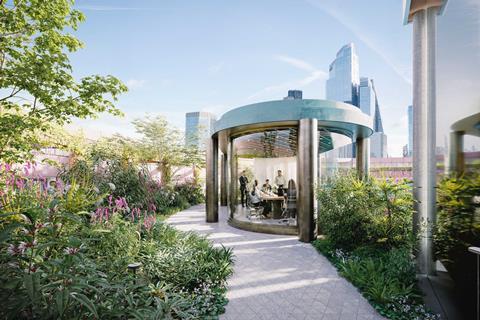
In a series of letters to the City, Bain argued plans to add a lift shaft overrun to the roof would harm the symmetry of the building, which Bain said had been one of Stirling’s “key fundamentals” for its original design.
“The Applicant has clearly failed to recognise the disruptive aspect of the proposed lift to the symmetry of the public roof garden when viewed from the gardens themselves,” Bain said on 16 March.
Three former JSMWA architects, Andrew Birds, Richard Portchmouth and Mike Russum, also wrote to object to the application, arguing that the proposed updates would disrupt the building’s “carefully calibrated symmetry”.
John Munro, a former employee of Michael Walford and Partners who worked on detailed design of the building, also argued the proposals were “ill-conceived” and threatened to “damage one of the most important British buildings of the 20th Century”.
Heritage groups which have objected to the scheme include the Twentieth Century Society and Documenting and Conserving the Modern Environment, although Historic England has not objected despite listing a series of concerns with the plans.
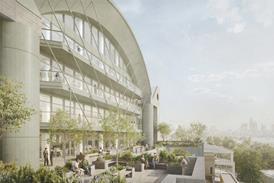
JRA’s plans for the building also include internal reconfigurations, building a new lift enclosure at roof level and replacing the roof garden, formerly occupied by the Coq D’Argent restaurant, with a public terrace.
Others working on the scheme include project manager Storey, cost consultant Quantem and heritage consultant Alan Baxter. Structural engineer is Civic, while Hilson Moran is on M&E and sustainability. Planning consultant is The Planning Lab while Studio GB is landscape architect.
No 1 Poultry was years in the making with an earlier, late 1960s plan by Mies Van der Rohe abandoned before Stirling was brought on board with James Stirling Michael Wilford and Associates’ design initially being submitted for planning in 1984.
But the job took nine years to clear planning hurdles, largely because of proposals to knock down the listed building occupied by luxury retailer Mappin & Webb.
It was finally given planning in 1993 with Laing beginning work the following year, although the scheme was one of several loss-making jobs the firm was carrying which eventually forced it to pull out of contracting.
No 1 Poultry is believed to have cost Laing at least £10m before it sold its construction business to O’Rourke for £1 in 2001.
Fore Partnership, IGIS Asset Management and JRA have been contacted for comment.





No comments yet