








A lot has changed since last year’s event - not least the man giving the big speech. Daniel Gayne headed to Liverpool to find out what Labour has planned for the built environment for the coming year
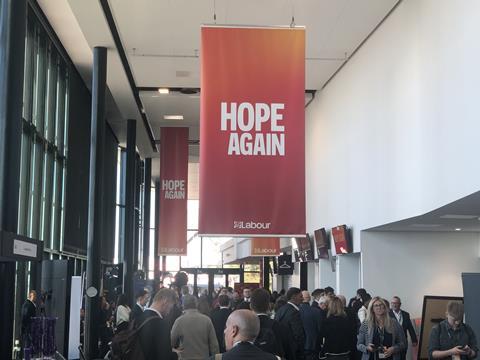
Anyone unsure of the message Labour wanted to get across at this year’s party conference would have been put right within a minute of arriving at the exhibition centre in Liverpool.
On every wall: HOPE AGAIN. On every screen: HOPE AGAIN. On every flag: HOPE AGAIN. A year ago, the omnipresence of such a cultish exhortation would have read as sign of desperation from the party spinners.
This year, its heavy-handedness obscured the fact that it reflected something real about the mood around the conference.
Around the housing and built environment fringes, there was a sense of a fresh start, a (possibly brief) moment for optimism – a marked contrast to the cognitive dissonance of last year, where Steve Reed’s ‘build baby build’ bombast fell flat among developers with real world frustrations and an exceptionally challenging market.
In one sense, not much has changed since then. Many of the same challenges around viability, affordability, and high costs of building and borrowing still persist. In another sense, we live in an entirely different world, with a freshly disrupted geopolitical environment and, of course, a new prime minister.
Labour puts the planning issue to bed, but leasehold troubles ‘far from solved’
On a more prosaic level, one of the big changes since last year is the introduction of a new National Planning Policy Framework (NPPF), which showed its impact in the relative lack of interest in the subject of planning on conference fringe panels that would usually be dominated by it.
It’s a fact that was not lost on attendees. “You kind of take a feel of what people are talking about at the conference and I’d say last year there was so much conversation about planning. This year, a lot less,” noted Mike Reeder, MP and former Mace director, addressing a panel on the housing market. One planning consultant that Building spoke to at the Big Housing Reception on Sunday evening remarked that he had been struggling to find enough events that were relevant to him.

The consensus around the fringes seemed to be that, while there could always be improvements to planning policy, Labour’s latest NPPF was a major step that should be given time to bed in.
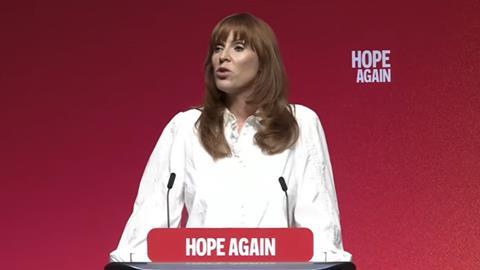
Judging from the housing secretary’s speech on Tuesday morning, the Ministry of Housing, Communities and Local Government’s (MHCLG) attention will now turn to tackling the issue of leasehold, which Angela Rayner described as “unfinished business”. She said she would take action to stop leaseholders being “ripped off”, promising new regulation of estate agents, letting agents and managing agents, Burnham’s keynote speech included a commitment to introduce legislation to reform leasehold tenures by Christmas.
Speaking on a panel addressing the subject, Kate Hendrick, from the National Leasehold Campaign, said that some people around the country think the leasehold problem has been sorted. “It’s so far from sorted,” she said.
Hendrick noted that leaseholders have the right to challenge their service charges at the first tier tribunal, but described this system “not fit for purpose” and said encouraging leaseholders to pursue that route “in the state that [the FTT]” is in was “not the answer”.
Said opponents of reform have “deep pockets” and that it would be a long and difficult battle for the government.
“The reality of it is leasehold will be around for a long time and we just have to be realistic,” she said, while making the case for urgent changes. “We need to abolish forfeiture,” she said. “That is the biggest threat that leaseholders face all the time. Pay this service charge or they’re going to go for forfeiture”.
On a Labour Housing Group panel, Rayner’s deputy Matthew Pennycook emphasised that tackling the problem was crucial for development. Noting that 96% of new homes in London were flatted, the housing minister said that “until we have really reformed the leasehold system, that tenure is going to remain a problem to people who are contemplating what their first home is”.
Not all are convinced by this. Speaking to Building, Barratt London’s managing director, Craig Carson, spoke of “misconceptions” around service charges and that “in our sales centres and our sales team, [leasehold] is not a question that really comes up”.
For private developers, effective demand and viability remain the big challenges.
Burnham’s demand-side stimulus a ‘natural pivot’, but ‘frank conversation’ needed on viability
There was good news related to the former as delegates headed to Liverpool, with Burnham announcing a new first-time buyer scheme ahead of the conference. Almost everyone Building spoke to around the conference struggled to remind themselves of the scheme’s name – Your First Home – perhaps because they have spent so long calling for the return of Help to Buy.
Calls for support for first-time buyers has become a staple of housebuilder’s annual reports over the past year, and so, even as they stumbled over the name, developers were keen to praise the government’s move.
“The fact that they have announced this is fantastic,” Paul Rickard. chief executive, of Pocket Living told Building. “It will definitely help.”
“If you look at the vast majority of SMEs, sales rates have gone through the floor, so it’s sort of a natural pivot to look at the other side of the pendulum,” said Hanad Darwish, head of external affairs and the Land, Planning and Development Federation told a fringe meeting.
For lobbyists and trade bodies, the realisation of one policy goal is simply an opportunity to move to a new battle. So it is with construction and development, where the next big push is sure to be viability (though the sector has not exactly been silent on the issue to date).
“In terms of the things that are impacting some of our members mostly on the ground, there’s viability,” said Darwish. “Policy sometimes doesn’t consider the cumulative effect of policy on outcomes. I think the layering of things – affordable housing requirements, environmental requirements, all very well meaning – I think that’s definitely an issue”. Mike Reeder agreed that MHCLG needed to have “a very frank conversation about what to be trying to achieve and what are the nice to haves”, mentioning swift bricks and rain water harvesting as examples of things which should not be made requirements.
Healey announces ‘downpayment’ on Milburn report, but sector must solve wellbeing issues to bring NEETs into the sector
One of the biggest topics around the more construction-focused parts of the fringe was NEETS – an issue which the sector sees simultaneously as a crisis and an opportunity.
These conversations took place under the cloud of the Milburn report, which is expected to set out its final findings soon – after which, we can expect the government’s strategy on the issue to be made much clearer.
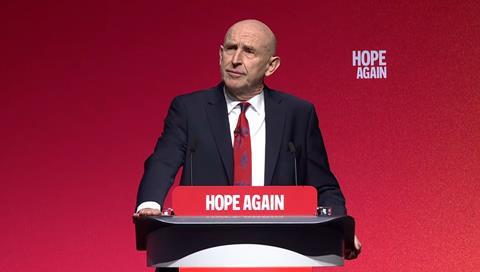
In his speech from the main stage, John Healey announced that Treasury would make a “down payment” on Milburn’s forthcoming work, committing to a £100m expansion of apprenticeships. He said the Local Apprenticeship Service, which will match young people with employers, would be available to any mayor in England who wants it. The Treasury said the programme will roll out across England next year and is fully funded through savings from a crackdown on fraud.
Discussion of NEETs around the fringe, however, emphasized that the challenges faced by would-be apprentices go beyond government funding.
At the Big Construction Breakfast on Monday morning, Amanda Martin, the chair of APPG for Trades People, pointed out that apprentices often lacked the means to get to construction sites or to afford to get lunch with their colleagues when they got there. She said she had been pushing for a “student loan-type thing” for apprenticeships - a supplement to living costs that they pay back when they are earning over £27,000. Martin also raised issues about the wellbeing issues in the industry putting off prospective entrants.
“We’ve got to make sure that there is reasonable notice around shifts and around compensation for short notice cancelations, statutory sick pay,” she said. “But one of the things I’ve been really pushing for is paternity leave with self-employed.” Martin framed these policies as part of a broader effort to improve wellbeing in a sector where people often spend long periods apart from their families and facing the financial pressures of being self-employed – stressed which prove too much for some. “It’s absolutely shocking that the biggest cause of death in this country is still suicide of under 50, and the construction industry is the biggest industry,” she said.
This consequences of this crisis were laid bare in an evening event outside of the conference secure zone. A panel convened by Unite the Union met upstairs in The Liverpool pub to discuss the problem of suicide among construction workers. Graham, a scaffolder, delivered a rending speech about the suicide of his son, of the same trade, and how it had affected his life. After his speech, Ritchie James, regional secretary at Unite, stressed the need for the government and industry to take action to solve the issue. “Behind every number is a family left shattered, mates who will never again share a site cabin and a trade short of the next generation of skilled hands”. He listed “long and irregular hours, extensive travel, long working, and high-levels of self-employment”, as among the issues facing.
Infrastructure advocates see opportunity in devolution drive, but Burnham’s prevarications over Heathrow frustrate
While housing was the more dominant topic across the built environment fringes, infrastructure received some attention too. At an event organised by Centre for London, Central London Forward and Business for Bakerloo, there were discussions about the possibilities of fiscal devolution for strategic investment.
London Assembly member Elly Baker said that funding certainty was “absolutely crucial” and that more power and over funding at the London level would give the certainty needed for delivery. “Everyone knows that if you do transport infrastructure, good things follow from it,” said Chris Hogwood, chief corporate affairs officer at Landsec, making the case for investment in the Bakerloo line upgrade and extension.
Panellists discussed infrastructure investment in the context of planned fiscal devolution, particularly the government’s plans to allow local governments to retain a portion of income tax. “It’s a really interesting tax to devolve,” said Mark Williams, director of Central London Forward. “It naturally encourages whoever it is devolved to to invest in projects and programs that support growth.”
However, there was some frustration about comments made by Andy Burnham on infrastructure. In an interview for the BBC, the prime minister said expansion plans were “a matter for Londoners”, refusing to back the scheme after the airport announced the £49bn project could be delayed by up to four years.
Chris Williamson and RIBA at Labour conference

With its sleek waterfront home near Albert Docks, RIBA is well set up to make the most of Labour Party conferences, which have in recent years settled on Liverpool as their default location.
The architecture body hosted a well-attended reception with Labour Housing Group on the first evening of the conference, with built environment professionals sharing drinks with MPs and local politicians.
On the Monday, it held a panel event in its exhibition space upstairs with the CIH, which is where Building Design caught up with president Chris Williamson.
Reflecting on the atmosphere of the conference, Williamson said there was “more of a mood of change than last year” and “a lot of anticipation”.
The RIBA president appears quite positive about the opportunities that come along with prime minister Burnham and his devolution agenda.
“We’ve got quite a combative development process in the UK,” he says, arguing that “devolution will help solve that because you need to be on the ground and seeing you know every area is different. The local knowledge and where the need is essential. You can’t dictate from central government to do that kind of community engagement.”
The change in political leadership also gives RIBA opportunity for a renewed push for city architects. This was the big policy ask that the organisation brought to the conference, touting case studies like Malmo and trying to sell politicians on the high satisfaction rates that cities with in-house public architects can boast.
“We can’t keep just banging on about good design,” Williamson says. “We have to look at how we can sell it to [politicians] and city architects and the high satisfaction rating that there is on the continent in cities that have them, they can see that that there might be some votes in it”.
Expertise beyond design is a big part of Williamson’s pitch for architects more generally. “Our design expertise is appreciated around the world, but I think politicians don’t understand that we don’t stress enough our expertise in different sectors,” he says, arguing that “the chairman of BDP knows more about hospitals than probably anybody here”.
Devolution brings an opportunity for architects to showcase that expertise. RIBA is suggesting pilot projects to introduce city architects at the level of devolved regional authorities and Williamson says he would “love it” if East Midlands, the region he was brought up in, was the first one.
But Williamson is keen that this does not simply mean cities or regions procuring architectural practices for advise. “I think you need the title and you need the authority just to be able to phone up developers, phone up investors, and initiate, not just wait for people,” he says.
It seems the lobbying drive is still in its early stages. Williamson tells me he has had “a couple of initial meetings with a couple of combined authorities, combined county authorities”.
But he appears patient, nonetheless. “It’s not going to happen overnight,” he acknowledges.
At the Centre for London event, Muhammed Butt, leader of Brent council, vented his frustration about the delay. “In that time, how many other countries would have built train lines and stations and airports and ports and everything else,” he said. “30 years down the road, we’re still talking. All right, if we’re serious about infrastructure, if we’re serious about growth, and creating those pathways for opportunity, for ambition and aspiration for our residents, we need to […] make things happen.”
Burnham makes bold pitch for ‘public control’ with big focus on housing – but no major announcements on new infrastructure
None of the media narrative ahead of the conference suggested that there would be a big announcement on infrastructure. But it’s notable, and unusual in the context of recent history, that none of the ongoing investments or big proposals got even a mention in the prime minister’s conference speech. Usually, there is some hat-tip to ‘spades in the ground’ on some or other big project.
When Burnham reached the end of his time on stage on Tuesday afternoon, it was understandable why such matters were omitted. This was big picture stuff – a bold pitch to bring “energy, water, housing back under public control”.

This included a bolstered Water Bill that would repeal the ban on public ownership of water companies, a new state-owned firm called Great British Grid, and a re-statement of his commitment to a council housebuilding revolution. “When people hear the phrase public control, I am sure some think it is anti-business,” he said, addres.sing critics of his more statist approach to government. “It is the opposite. Businesses need the basics to be functional and affordable too”
For those in the housing sector, it’s clear this agenda will be consequential – although the details on exactly what the future looks like remain shaky. For infrastructure developers and investors, there remains a big question mark over what ‘public control’ will actually mean and what knock-on effect it might have for consultancies and contractors working in this area.
It’s worth remembering that Burnham has been PM for less than three months and with an early election supposedly ruled out, this story has a lot of time left to run.







No comments yet