





At a recent supper club at the offices of Ackroyd Lowrie, architects discussed what the technology means for the future of the profession. Guests asked what will remain for architects given the rapid encroachment of AI into their traditional roles. Oliver Lowrie believes he may have the answer.
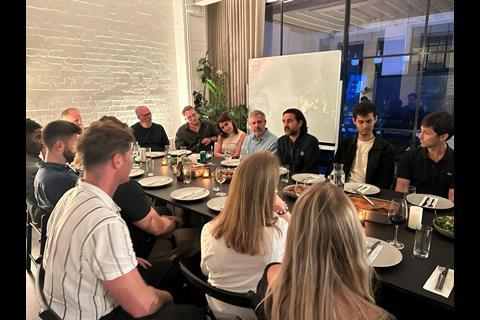
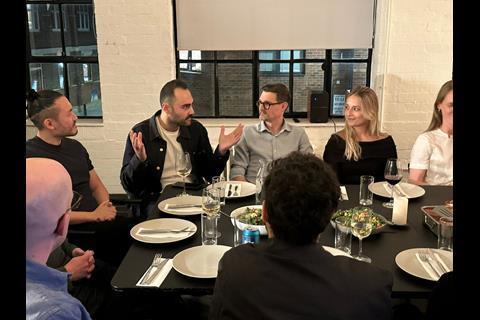
Last Thursday, we invited 22 of the architects pushing AI furthest into a room and asked them a simple question: what should AI actually be allowed to do? The background of the Built Environment AI Supper Club is that we have been running it to try and create a consensus on how built environment practitioners should safely embrace this wildly powerful technology, without letting it burn our wings off. This one was very intentionally almost entirely practising architects, (plus BD’s own Tom Lowe). These were not the sceptics. They were people already deep in it, from practices and businesses actively testing how far these tools can go, such as Heatherwick, Fosters, and Studio Tim Fu.
The reason we run the Supper Club is simple. We want to be at the forefront of this change, but not simply for the sake of adopting technology. Our aim is to make better cities for people. Technology is going to change the role of the designer, whether we like it or not, and the purpose of the supper club is to try to bring people together to protect a version of that future in which these tools produce better outcomes for humans.
The immediate context of this month’s supper club was widespread coverage of Chat GPT’s new Astra model, which has smashed benchmarks for handling 2D and 3D information.
Whilst Linkedin, Instagram and X are full of videos of Astra recreating 3D models from historic drawings, connecting to Python and Rhino to create fluid geometry reminiscent of the heyday of 2010s Parametricism, I wanted to test it on something mundane but potentially very useful… a mansard extension on my house.
And I wanted to see what was possible without actually using any CAD software, and with minimal prompting.
I put in my address. Astra found an old planning application on the portal, downloaded the plans and elevations, and modelled up the existing building in about 5 minutes using Blender.
Since I have never used Blender, this was kind of impressive, but also a bit pointless, since I couldn’t even work out how to rotate the viewpoint.
So I asked for drawings sheeted up at 1:100 for planning.
They aren’t perfect. But I reckon one round of red pen markups would get them ready to submit. I never opened any drawing software. I don’t even know what it used to produce the sheets. The whole thing took less than an hour, and replaced a task that might previously have taken 2-3 days.
I’m not recounting this to show off my incredible technical ability - quite the opposite. I’ve not really been seriously using BIM/CAD for the best part of a decade, and I was able to effectively vibe code a planning set. What does it mean for architects, when drawing can be done faster by AI?
This was the framing of this month’s AI Supper Club. I expected disagreement, but I also, perhaps naively, expected we would reach some sort of consensus. We didn’t. But the discussion along the way was an absolute rollercoaster.
The first response around the table to the question of how we should engage with AI tools was, in essence: “just go for it”. The genie is out of the bottle. This is happening whether we approve of it or not. Get very good at it and stop worrying.
It is a seductive position. But over the course of dinner the conversation kept swinging, from maximalist technological abundance to something much closer to dystopia. Because ‘just go for it’ leads very quickly to two more questions: firstly - go where? And secondly - are architects going to be necessary towards the latter part of the journey?
We have spent the last few years telling ourselves that AI will remove the boring bits and leave architects more time to do the creative work.
But Astra, the latest model of Chat GPT, looks like it is quite happy to have a go at doing the creative work too.
It is certainly a very powerful drafting tool, even if the creativity still sits with the human doing the prompting. And the speed at which it can draft (with increasing accuracy) is about to send a nuclear bomb into the architectural industry.
One suggestion on the night was technical knowledge remains the Architect’s moat. Architects know how buildings go together - whereas AI doesn’t. That is true, for now. But follow the trend line far enough and that gets uncomfortable too. Pair AI with robotics and another drive for efficiency in the construction sector, and suddenly knowing how a building goes together is not necessarily the same thing as being central to the process. If the machine knows how to design it and another machine knows how to build it, does it matter what the architect knows?
That point in the conversation was roughly when someone cheerfully offered: ‘I think it’s all going to be fine. We can always just be farmers.’
Another answer was taste. I like that one much more. Architecture is not simply the optimisation of a set of measurable inputs. Someone has to decide what is good. Someone has to understand what a place feels like, what people value and what kind of city we actually want to live in.
But I am not sure taste is quite enough either. Architects already have less influence over the development process than we sometimes like to admit. We are often window dressing a massing that is the result of a site allocation, plus the price the developer paid for it. Calling ourselves tastemakers does not automatically put us back at the centre of the places we are making.
The most interesting suggestion of the evening was a single word: responsibility.
Keir Regan Alexander, who has been studying the impact of AI on the industry longer than most stated that perhaps responsibility is the architect’s moat, and we should take more of it.
This makes sense to me. As architects, we are used to taking responsibility for decisions that cost our clients money and affect the people who use our buildings. When we specify a material or issue a drawing, we know that someone is going to act on it. If we get it wrong, there are consequences, and we can expect to be asked to explain our decision.
That feels increasingly important in an AI-mediated world. If you cannot be accountable for an output, perhaps you should not be making that decision.
And perhaps that points towards a more useful role for architects. Not as the people who can draw better than everyone else, because that advantage is disappearing. Not simply as custodians of technical knowledge, because machines will increasingly possess that too. But as a bridge between technology and humans. Taking responsibility for making decisions based on analysis, experience, and taste.
That is a role I can get excited about. These systems can process extraordinary amounts of information, test possibilities and expose relationships that a human designer might never see. Used well, they could make us better informed, more rigorous designers. They could give every design decision a traceable history: why is that wall there, which policy informed it, what alternatives were considered, and who ultimately decided?
But the human still needs to own the answer. That is design responsibility.
The important question is no longer whether architects should use AI. We already are. It is what we choose to remain responsible for as the technology gets better, and whether we can use that responsibility to keep humans at the heart of the cities that emerge.
And yes, I used AI to help me write this. But these are still my words. So hopefully we will find a way to allow creativity to be powered by AI rather than eroded into slop.
Postscript
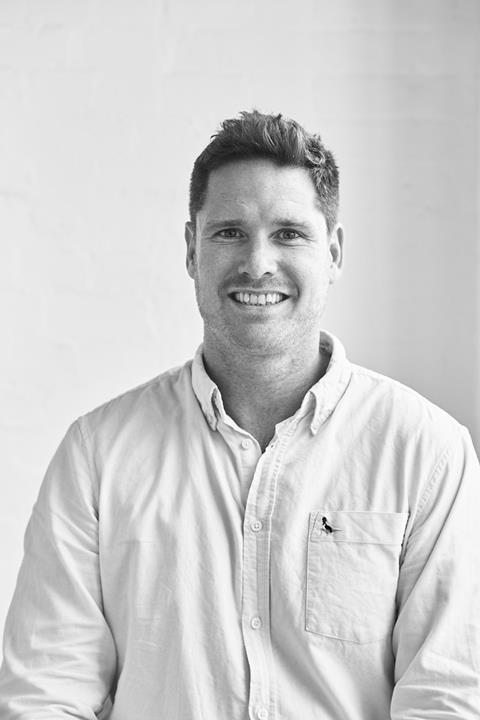
Oliver Lowrie is an architect and co-founder of Ackroyd Lowrie and co-host of the Urban Forecast podcast







3 Readers' comments