




For well over half a century there have been proposals to reduce traffic on Europe’s busiest street and transform it into a more pedestrian-friendly area. Tom Lowe meets the team finally taking those plans towards fruition
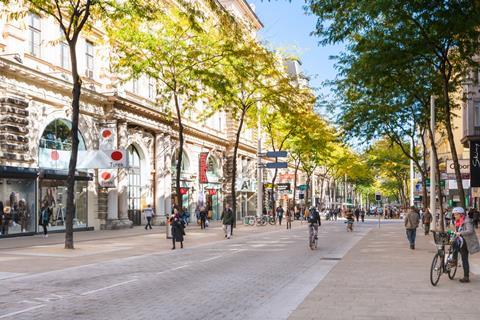
A few years ago, I was wandering through central Vienna and found myself walking down a wide, tree-lined shopping street. Familiar brands lined either side – H&M, Intersport, Starbucks – but, despite the sunny spring afternoon, it was quiet. Or, at least, it felt quiet.
It was smartly paved along its length, with two wide pavements flanking a narrow road with no kerbs. Occasionally, a car would crawl politely by.
After some Googling, I realised that this leafy street was the Mariahilfer Strasse, the Austrian capital’s main commercial thoroughfare. As a visitor from London, this came as a bit of a shock.
The inner section of Mariahilfer Strasse, which runs for 2km towards the edge of the city’s old town, was pedestrianised in stages between 2013 and 2014 under Vienna’s red-green coalition government. The result is a pleasantly calm pedestrian experience, suitable for relaxed ambling or an al fresco lunch.
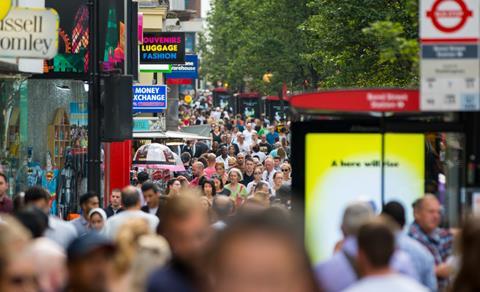
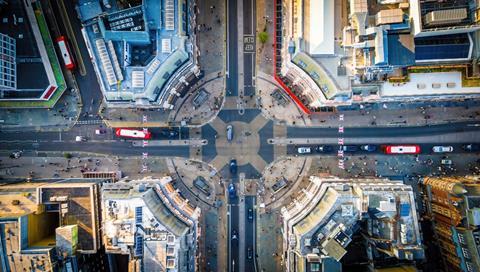
The contrast with London’s Oxford Street – Europe’s busiest street – is somewhat alarming. Anyone who knows the UK’s version of the Mariahilfer Strasse will be familiar with the dangerously overcrowded squeeze around Oxford Circus and the sounds of fluorescent pedicabs blasting out Vengaboys on a Sunday afternoon.
On its busiest days, even a short exposure is an exercise in managing the symptoms of a panic attack. The familiar street preachers shouting through microphones about the apocalypse and salvation don’t help, but at least they are working with the right audience.
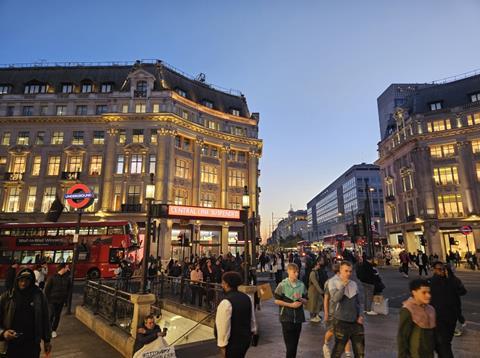
Thankfully, the street is now set to undergo its own pedestrianisation transformation under plans being drawn up by urban realm practice East, which is working on a 1km stretch between Great Portland Street in the east and Orchard Street in the west. Meanwhile, Hawkins Brown is working on a wider masterplan for the entire street up to Tottenham Court Road. The question is, why hasn’t it happened until now?
The project has a long history. Plans in the 1960s to cover much of the street with a giant roof and turn it into a kind of multi-level indoor shopping mall were scrapped due to high costs. Sadiq Khan’s plans to pedestrianise the street, designed by Publica, were blocked by the Conservative-led Westminster council in 2018 due to concerns about the impact of shifting traffic onto surrounding streets.
In 2024, Khan brought the scheme back with a new strategy involving a mayoral development corporation, established on 1 January this year, which is intended to bypass local opposition. Pedestrianisation is set to start from this September, with all private vehicles, buses, taxis, cycles, scooters and, yes, pedicabs banned from the initial 925m-long stretch. Services and delivery vehicles will be allowed access between midnight and 7am.
There’s this kind of incredible paradox – how can you have a place that no one wants to go to, but that everyone goes to and knows about?
Julian Lewis, director, East
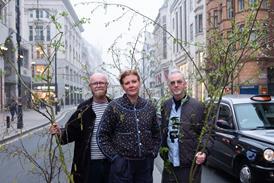
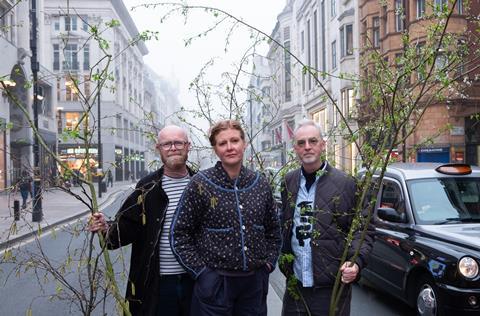
East’s work is still in its early phases, but I sat down with director Julian Lewis at the firm’s office in Hackney to find out what is guiding its vision for the project. The practice was appointed through City Hall’s architecture and urbanism framework, but would have had a strong pitch for the job even if it had been an open competition.
East’s first project when the practice was set up in the mid-1990s was a regeneration of Borough High Street, part of an early plan to raise the profile of the south bank of the Thames opposite the City of London. The practice has since worked on around 30 public realm and high street projects, including Wood Green and Beckenham high streets. For Lewis, Oxford Street feels like the culmination of three decades of reimagining public spaces.
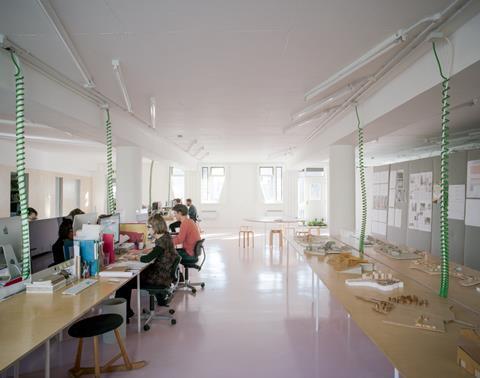
“It feels incredible to be working on a project where just about anyone you spoke to in the street would know where you mean. That has never happened before. And I think, because everyone has an opinion on it, or at least knows about it, it feels like a massive privilege to be involved in it,” Lewis says.
But, while he describes Oxford Street as “completely iconic,” and a place which has “always had this sense of the excitement of London”, Lewis is mindful of the public’s often ambivalent attitude towards it. “Obviously, it’s quite unpleasant to be there, and yet everyone goes there. And so there’s this kind of incredible paradox – how can you have a place that no one wants to go to, but that everyone goes to and knows about?”
One approach the practice is looking at to make the area more pleasant is to draw more people into surrounding streets, which are often – especially on the northern side – surprisingly deserted in comparison. However, as pleasant as Vienna’s pedestrianisation approach might be, the goal is not to neutralise Oxford Street’s vibrancy but to embrace it in a way which benefits pedestrians.
Lewis describes it as a kind of long and thin Trafalgar Square, an unusual combination of shopping and public space which has taken on some of the flavour of Speaker’s Corner, the historic public speaking and protest spot near Marble Arch. There has been talk of the street taking on a more events-focused role, given that one of the consultants on the scheme is Gehl Architects, which worked on the transformation of New York’s Times Square.
Lewis says he wants to provide enough space in front of key locations, including some of the larger department stores, for events to take place.
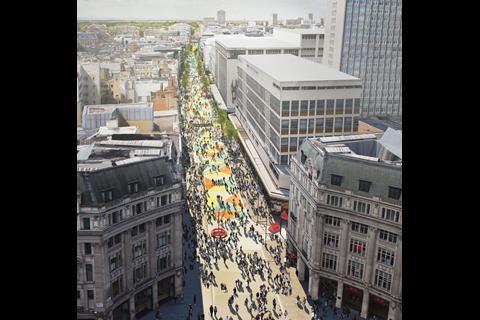
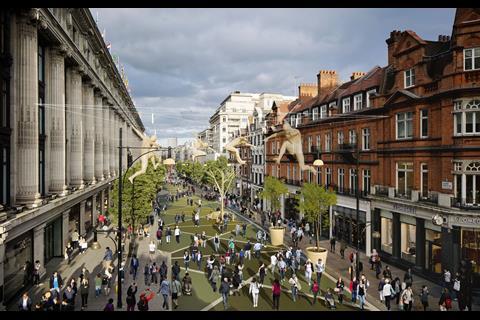
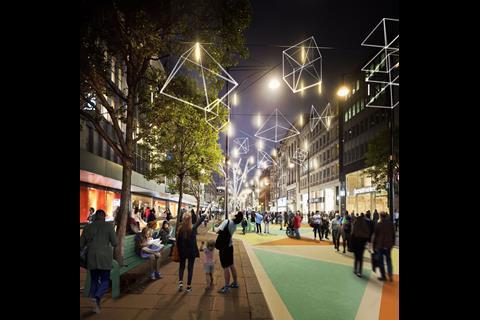
He says he is also looking to transform Oxford Circus, as the central nexus of the area, into a place where people will want to congregate rather than just “get the hell out” as is often the case currently. “I think something prominent there is important,” he says.
One option the practice is looking at is a giant, ring-shaped “crown” which would sit above the site’s four corner buildings. The structure would essentially be a huge screen, covered in points of light which could be programmed to produce any kind of image.
Given all four quadrant buildings on Oxford Circus are grade II-listed, this will undoubtedly ruffle a few feathers in the heritage sector. But Lewis is up for a fight: “I’m really up for that. Let’s talk about it. Let’s see what the benefits and disbenefits are.”
One of his inspirations for how the street should look is Virginia Woolf’s 1932 essay Oxford Street Tide. Woolf wrote about the street in an unromantic and often unflattering way, famously describing the “careless, remorseless tide” of shoppers who wash up and down the thoroughfare, polishing its pebbles.
“She is writing about it as this gaudy, noisy, busy, lively part of London. She’s kind of loving it, but also seeing all the gritty challenges to it. So I think she puts her finger on the idea that Oxford Street is part of London’s life,” Lewis says.
He says the concept of a flow has given him a notion of a kind of “flotilla” of seats and objects which people walk past, and a sense of river-like movement which he wants the street to evoke. The project team is working on the assumption that the initial stretch between Orchard Street and Great Portland Street will be entirely repaved, with Lewis favouring small, irregularly laid shiny black granite stones which feel like a “gravelly, pebbly bed”, contrasted with white stone for the seats, kiosk structures and planters.
“All the bright signs – the advertising, the shop fronts – are enough to light the space all by itself. So there’s a sort of need for the paving not to try to be too much in your face, but feel like it’s moving,” Lewis says.
This black riverbed concept has also been inspired by the Tyburn, one of London’s lost rivers, which flows directly under Oxford Street in a culvert near the junction with Bond Street. Lewis wants there to be a fountain near this location, as if the river has “sprung a leak”.
Greenery will also be central to the street’s transformation, with landscape architect J&L Gibbons working with East on the initial phase. One of the first interventions could be two large trees, one placed at either end of the initial stretch, to bookend the site and “kind of announce that something’s changing”, Lewis says.
More large trees will be added early in the project in air pots, left to grow and later planted in the ground when the project allows.
In this respect the transformation of Oxford Street is similar to other major pedestrianisation projects around Europe which have created calmer, greener and quieter spaces. But there is only so much you can do to calm down a place like Oxford Street.
What we’re interested in doing is finding what Oxford Street is about already and has been historically, and trying to evolve that
Julian Lewis, director, East
It is unlikely to end up like Mariahilfer Strasse, and neither should it. East is envisaging something livelier, a space which celebrates the city centre’s hustle and bustle and can provide a fitting backdrop for buzzy public events.
“It’s about doing something that people understand. That’s the way I see it,” Lewis says. “And so, what we’re interested in doing is finding what Oxford Street is about already and has been historically, and trying to evolve that.
“So, although it’s transformative, it’s also something that can be seen to be part of the evolution of this part of London – just making it into more of an asset than it is at the moment.”


No comments yet